







You went to your doctor. You described exactly what you’ve been feeling, and you waited while they ran the tests. Then the results came back “normal.”
But you don’t feel normal. You feel exhausted by two o’clock in the afternoon. Your digestion is unpredictable. You’re not feeling like your usual best self, and nobody can tell you why.
If that sounds familiar, you’re not alone, and you’re not imagining it.
This is the exact gap that functional medicine was built to close: the space between “your labs look fine” and “you feel awful.”
The trouble is, the term “functional medicine” gets used so loosely these days that it’s hard to know what it actually means, or whether it’s the right fit for what you’re going through.
So let’s clear that up. Here’s a real breakdown of how functional and conventional medicine differ, where each one earns its keep, and why so many people across Denver are making the switch after years of being told everything looks fine.
What Conventional Medicine Does Well
Conventional medicine is exceptional at what it was built for: acute care. A broken arm, a bacterial infection, a heart attack in progress, an appendix about to rupture. In moments like those, you want a conventional physician, and you want them fast.
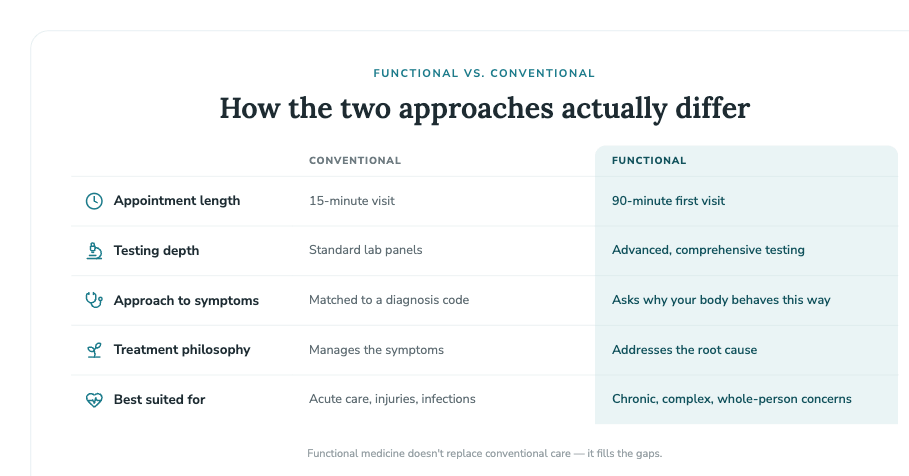
Speed is the whole design. A fifteen-minute appointment can handle a lot when the problem is clear-cut, a strep swab, a prescription, or a follow-up if things don’t improve. Standardized protocols and diagnostic codes make the entire system scalable, which is exactly what a hospital needs when it’s treating hundreds of patients a day.
The trouble with conventional medicine begins when it runs into chronic illness, prevention, or health optimization. Conditions that build slowly over years, touch multiple systems at once, and can’t be resolved by medication alone. That’s where conventional medicine falls exceptionally short.
Where Conventional Medicine Falls Short
Conventional medicine is not designed to address the root cause or investigate the “why” behind what’s actually driving your symptoms or condition. It’s designed to treat symptoms, often quickly, but symptoms are far different from root causes.
Conventional appointments simply don’t leave room for that kind of digging. A provider sees your symptoms, matches them to a diagnosis code, prescribes accordingly, and moves to the next patient. That’s not a failure of the doctor sitting across from you. It’s the structure they’re working inside, an insurance-based system that rewards output, not investigation.
And the results of this approach show up in many frustrating ways. Someone with Hashimoto’s gets their TSH checked, but never their antibodies. A patient with gut discomfort gets handed an IBS diagnosis, with no real investigation into why their gut stopped working properly in the first place. A mom with constant fatigue gets told everything looks “normal,” even though they know with certainty that something is off.
What Functional Medicine Actually Does
Functional medicine starts with a different question entirely. Instead of asking which condition matches your symptoms, it asks why your body started behaving this way in the first place.
At PrimeHealth Denver, that question shapes everything about how we work with you. Your first appointment runs 90 minutes instead of 15, because your story deserves more than a rushed appointment. You deserve a practitioner with enough time to truly understand what you’ve been experiencing. From there, we use advanced diagnostic testing that goes well beyond a standard lab panel, and we build a detailed protocol around your diet, your stress levels, your sleep, your environment, and the medical events that shaped your health long before today showed up in our office. All of it feeds into one outcome: a treatment plan built around your own biology, not a protocol pulled off a shelf.
To be clear, our 90-minute visit isn’t a universal standard you’ll find at every functional medicine practice. It’s simply how we’ve chosen to do things at PrimeHealth, because we don’t believe you can get to the root of your condition and optimize health in a rushed conversation.
The Testing Difference
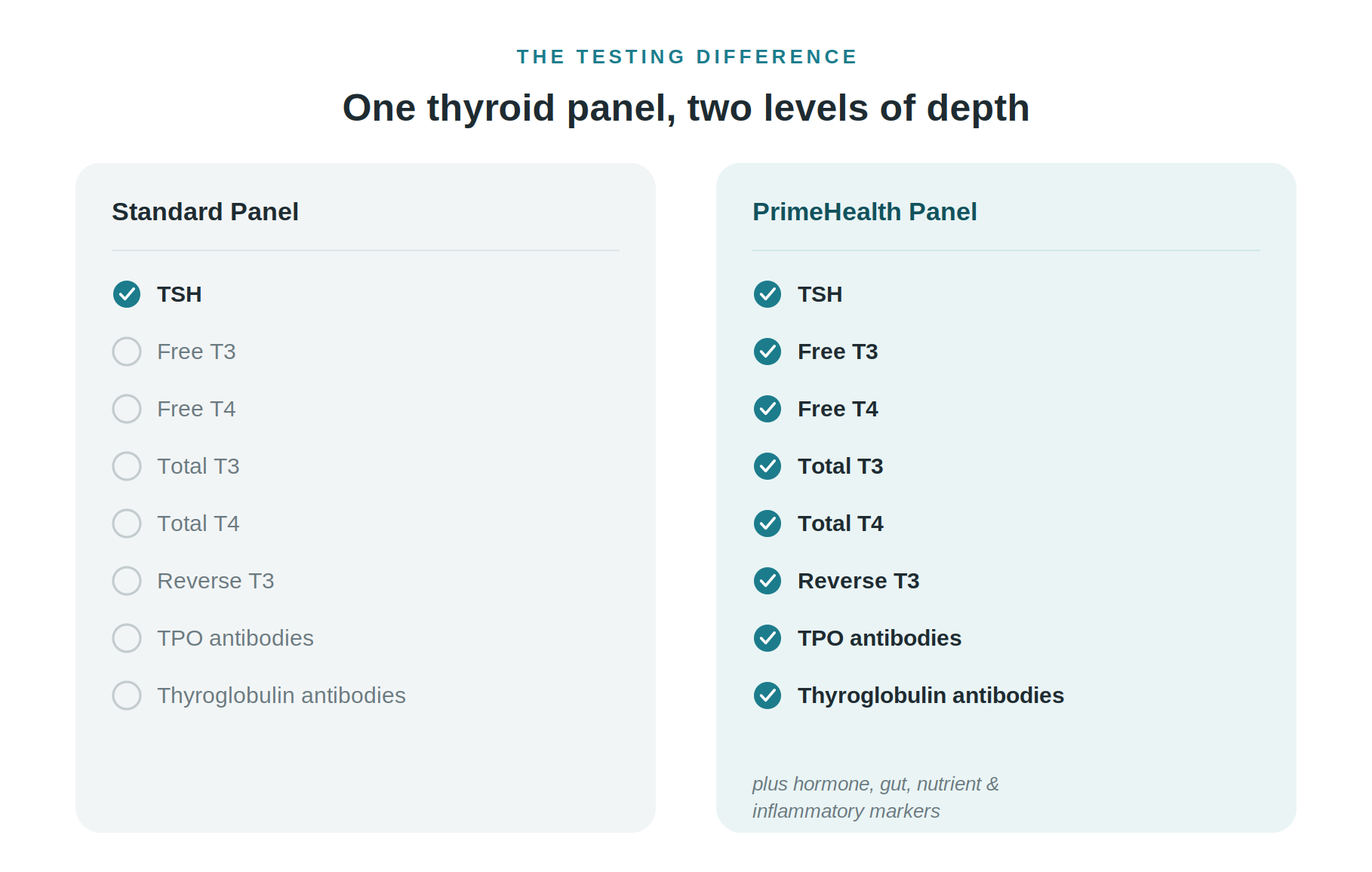
One of the most concrete differences between the two approaches comes down to what actually gets tested.
A conventional thyroid panel usually checks one thing: TSH. A functional medicine thyroid panel goes much further, looking at Free T3, Free T4, Total T3, Total T4, Reverse T3, TPO antibodies, thyroglobulin antibodies, and more. That additional data can completely change the picture of what’s going on in your body.
The same holds true for hormones, gut health, nutrient levels, and inflammatory markers. Standard labs are built to catch disease once it’s already progressed to late stages. Functional labs are built to catch dysfunction while it’s still forming, long before it turns into something more serious.
Who Is Functional Medicine Right For?
In short, functional medicine is for everyone who wants to feel better, optimize health, and be proactive. Maybe you’re living with a chronic condition that hasn’t budged, no matter what you’ve tried. Maybe you’ve been told your labs are normal more times than you can count, but you still don’t feel like yourself. Or maybe it’s not just one thing. Fatigue, digestion, mood, all tangled together in a way that makes it hard to know where to even start.
Some people come to us because they’re done managing a problem and ready to understand it. Others aren’t struggling with anything specific; they just care about longevity and performance, and they want their health optimized, not just adequate.
If any of that sounds like you, keep reading.
It’s worth saying plainly: functional medicine isn’t a quick fix. Functional medicine asks something of you: time, participation, a real willingness to make changes. Most patients start seeing meaningful improvement within 2-3 months. Some reach significant resolution within six.
Patient Story
A woman in her early 40s came to PrimeHealth feeling frustrated, exhausted, and completely defeated. For years, she’d lived with fatigue that never lifted, brain fog that wouldn’t clear, stubborn weight gain, bloating, and digestive discomfort that colored nearly every day. She’d seen provider after provider. She’d completed test after test. And every time, she heard the same two words: “everything’s normal.”
But she knew her body better than any chart could. She knew this wasn’t normal.
By the time she found PrimeHealth, her symptoms had crept into nearly every corner of her life. She had less energy left for her family by the end of the day. She struggled to concentrate at work. She hadn’t felt like herself in longer than she wanted to admit.
We started with a comprehensive functional medicine evaluation, testing that went far deeper than anything she’d had before, and just as importantly, we listened. What we found was thyroid autoimmunity, nutrient deficiencies, gut dysfunction, and chronic inflammation, all quietly working against her at once. Instead of masking those symptoms one at a time, her care plan went after the causes directly: personalized nutrition, targeted supplementation, stress management, better sleep, gut restoration, and more.
Over the following months, things started to shift. Her energy came back first. Then the fog lifted. Her digestion settled down, and she found herself back in the gym, moving through her days with a kind of confidence she hadn’t felt in years.
But the biggest change wasn’t physical. For the first time in a long time, she felt heard. She had real answers, an actual plan, and the confidence that her body could heal.
Every patient’s path looks different. But her story captures something true about what functional medicine offers: the moment you stop asking “what’s wrong with me?” and start asking “why is this happening?”, an entirely different road to healing opens up.
“I went into functional medicine to help the patients who don’t fit neatly into a diagnostic box, the ones who know something isn’t right but have been told everything looks ‘normal.’ I believe our role is to uncover root causes, educate patients on all of their treatment options from lifestyle changes to supplements to medications and specialist care, and empower them to make informed decisions alongside a provider who truly listens.”
– PrimeHealth Denver Physician
Getting Started
PrimeHealth Denver offers a free 20-minute consultation to help you understand whether functional medicine is the right fit for you. You’ll speak with a wellness consultant, share your health history and goals, and walk away with a clear sense of how a root-cause approach could help you feel like yourself again.
If you’re ready to try a functional medicine approach to your care, book a free consultation today.